
Why "How Long Will This Last?" Is the Wrong Question
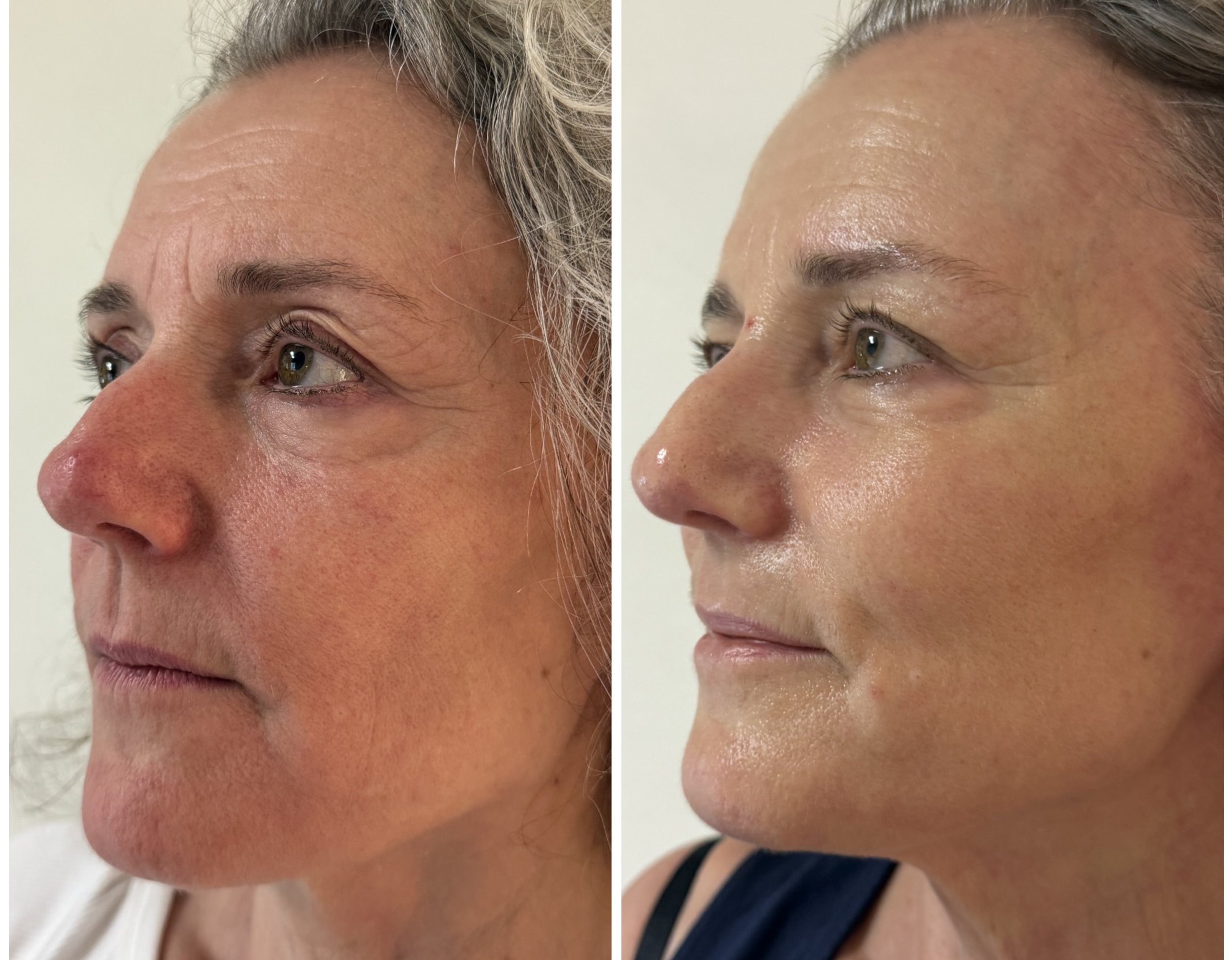
Long time client above who has had Fibroblast in prior years and now T33 -3 sessions
It's the first thing every client asks before they book a Fibroblast Plasma Lift or a T33 session: how long will this last?
It's a fair question. It's also one that doesn't have a single honest answer — and any practitioner who gives you a clean number without asking you a single thing about your life first is giving you a marketing line, not a clinical one.
Regeneration isn't a purchase. It's a process you join.
A regenerative treatment doesn't install a result. It triggers a biological process — collagen remodeling, fibroblast activation, tissue tightening — and then hands that process off to your body to carry out over the following weeks and months. The device does its part in the treatment room. Everything after that is physiology, and physiology is not identical from person to person.
That's why "results last 1–2 years" is, at best, an average pulled from a population — not a prediction for the individual sitting in the chair. The real answer depends on variables that have nothing to do with the device and everything to do with the person receiving it.
Age changes the raw material
Fibroblast activity — your skin's own collagen- and elastin-producing capacity — declines with age. A treatment performed at 35 is working with a more responsive, more abundant cellular population than the same treatment performed at 60. That doesn't mean regenerative treatments stop working as we age; it means the rate and ceiling of the response shift, and the maintenance conversation has to shift with it.
Genetics set the boundaries
Some clients are simply better collagen producers than others. Skin thickness, elastin quality, healing speed, and even how visibly the skin responds to micro-injury are all influenced by genetics before a single treatment ever begins. Two clients with identical protocols, identical aftercare, and identical lifestyles can still see different timelines — because their starting biology isn't the same.
Lifestyle determines how fast the gains erode
Sun exposure, smoking, sleep, hydration, stress, and diet all accelerate or protect against collagen breakdown. A client who is diligent with SPF and sleep is not on the same clock as a client who spends weekends unprotected in the sun. The treatment doesn't know the difference — but the outcome will show it.
Daily products either extend the result or quietly undo it
This is the piece that gets skipped most often, and it matters more than people expect. Regenerative treatments improve the skin's capacity to build collagen; they don't override what you put on that skin every single day. A barrier that's compromised by the wrong actives, insufficient SPF, or a skincare routine that isn't suited to the treated skin will degrade results faster — no matter how well the procedure itself was performed. What you do on day 2 and day 200 is doing as much work as what happened in the treatment room on day 1. This is why we give knowledge on the right products for each clientele and provide products after your first service as well.
Where cold plasma fits into the maintenance picture
This is exactly why we recommend T33 cold plasma as a follow-up to Fibroblast Plasma Lift for certain clients — particularly the ones whose lifestyle works against them. If you work outside, travel constantly, or simply don't have the time or bandwidth to maintain a meticulous daily routine, you're accumulating more collagen breakdown between visits than someone who can control their sun exposure and stick to a disciplined regimen. That's not a character flaw — it's just reality for a lot of people's lives and careers.
T33 works well here because it's a gentler, more repeatable maintenance tool. Used proactively after a fibroblast treatment, it acts as a preventative layer — helping to reinforce and extend the results of the initial rebuild rather than waiting for them to fully fade before starting over. And on its own, T33 can produce results that rival fibroblast in combating visible aging — but that outcome still depends on the same conditions as any regenerative treatment: the right products, consistent use, and a client who's actually proactive about their skin between sessions. Cold plasma reduces the margin for error that a demanding lifestyle creates. It doesn't remove the need for daily care altogether.
The dental analogy
Think about the last time you had your teeth professionally cleaned. That single appointment doesn't keep your teeth clean for the rest of the year — and no dentist would ever tell you it does. The cleaning removes what's built up and resets a baseline. What keeps your teeth healthy after that appointment is what you do every single day: brushing, flossing, the choices you make between visits.
Nobody expects one dental visit to replace daily brushing. And yet skin is frequently sold the opposite story — as if one treatment should replace daily care entirely, indefinitely.
Skin works the same way teeth do. A regenerative treatment resets and rebuilds a foundation. Daily care — the right products, consistent use, real protection — is what maintains it. Skip the daily part, and the foundation still degrades, just as your teeth would without brushing, regardless of how good that last cleaning was.
What we tell clients instead of a number
Rather than promising a fixed timeline, the more honest — and more useful — approach is to talk about the factors that will determine their individual outcome:
Where their skin is starting from, and what their goals actually require
What their daily routine looks like, and whether it's supporting or working against the treatment
Their sun exposure, habits, and general lifestyle load on the skin
A realistic maintenance rhythm — because regenerative treatments are a relationship with your skin, not a single transaction
Whether a preventative follow-up like T33 cold plasma makes sense for their specific lifestyle, especially if sun exposure or time constraints make daily discipline harder to sustain
That conversation is less satisfying than a clean "12–18 months" answer. It's also the truth, and it's what actually sets clients up to get — and keep — the results they're paying for.
The takeaway: a regenerative treatment gives your skin the tools to rebuild. What you do every day after determines how long that rebuild holds.